 Low Back Pain Coach
Why does my lower back hurt on back extensions?
Three things are worth checking first when your lower back hurts on back extensions: the pad sits too high, you go past a straight line at the top, or nothing tells you to do less the next day. Week one on a 45-degree bench shows the setup, the stop point and the next-day rule in order. Back extensions should make the muscles along your lower back, glutes, and hamstrings work hard, and you should feel that effort. Sharp pain, pain that spreads, or pain that climbs a little after every session means something needs to change.
This page covers two situations: pain during the rep, and a flare the next morning after a short hold, which can make you afraid to try again. Back extensions are not suitable for everyone. If you have a diagnosed disc herniation or spinal stenosis, or you are not sure, ask the clinician who knows your back before you load it.
Start with the setup, then the range, then the dose. Change one thing per session so you can tell which change mattered. If the pain is in your legs, skip the checklist, stop the extension work, and do not add load.
Pad at the hip crease
The top edge of the pad belongs at the crease where your thighs meet your pelvis, with your hip bones sitting a little above it. Set too high, the pad sits under your stomach and pinches you at the bottom of each rep. Set it so your hips sit on the pad and your back is free to round on the way down and straighten on the way up. Set too low, you lose support.
Stop at a straight line
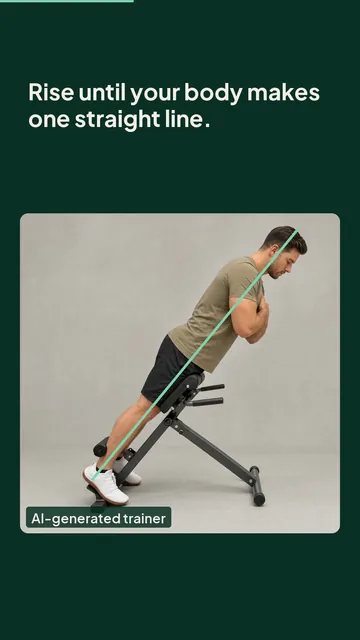
At the top, your shoulders, hips, and ankles should form a straight line. Stop there. Pushing your chest higher arches your lower back, and some backs do not like that. You should feel the muscles along your spine working. A pinch at the top, or pain that sharpens as you rise, means you are going too high.
Less range
A longer range asks more of your back than a short one. Go back to a hold at the top, or lower only a few inches and come back up, and keep that range the same for the whole set. The four-stage progression starts with holds and adds partial reps before full range for this reason. Stay at the earlier stage until it goes well across several sessions.
Round under control
On partial and full reps, let your back round on the way down and straighten as you come up, with your hips staying on the pad. The spine is meant to move through the rep. If it drops suddenly into rounding at the bottom, or your hips slide on the pad, shorten the range until the whole rep is smooth.
A slower descent
Take 2 or 3 seconds to lower. Avoid dropping into the bottom or bouncing out. Lowering slowly also gives you time to stop if something changes.
A smaller dose
If your setup is consistent and pain rises after sessions, cut the work. After a morning above baseline the app reduces its next session. That is a program rule, not a clinical threshold: holds and full-rep sets drop by about 30 percent, partial reps lose up to a rep and up to 10 percentage points of range (stopping at 2 reps and 40% range), and weighted sessions drop 5 lb while the plate is above 5 lb or lose up to 2 reps at 5 lb (stopping at 6). From Stage 2 on, a session already at the minimum steps back one stage. Keep a day between sessions; the frequency guide covers spacing.
If the setup is right and you want the next session to get shorter after a morning worse than your usual, the app does that. The program needs a 45-degree back-extension bench. The first guided session in Low Back Pain Coach is free, and without a plan the pain log, lessons and flare-up help stay free. After that it is $59.99 a year or $9.99 a month, with a 7-day free trial for eligible new subscribers. Week one on the bench shows the first session first.


If it flared the next day
In this program the next session gets smaller when the morning is worse than your baseline: holds and full-rep sets drop by about 30 percent, partial reps lose up to a rep and up to 10 percentage points of range (stopping at 2 reps and 40% range), and weighted sessions drop 5 lb while the plate is above 5 lb or lose up to 2 reps at 5 lb (stopping at 6). From Stage 2 on, a session already at the minimum steps back one stage. These are program rules, not clinical thresholds, and a pain score cannot tell you what caused the change. If a short hold at the top is already too much, stop and ask a clinician whether floor or bench exercises suit you.
Soreness or something else
Delayed muscle soreness typically starts 12 to 24 hours after unfamiliar exercise and may be strongest 24 to 72 hours afterward. Timing alone cannot tell you what caused your pain.
End the set if pain turns sharp, electric, or suddenly severe. If the pain is in your legs, stop the extension work and do not add load. Go to emergency care now for new numbness, tingling or change in feeling in the saddle area (groin, inner thighs, genitals or anus), new changes in sexual function, new bladder or bowel changes, new pain, tingling, numbness or weakness in both legs, leg or foot weakness that is getting worse, or back pain after a recent serious accident. See a clinician today for other new weakness or numbness in one leg or foot, fever or chills alongside the back pain, new pain after a recent smaller fall or knock, unexplained weight loss or a history of cancer, pain that is rapidly getting worse, or pain that is constant at rest and worse at night, not tied to movement. Use urgent care if you cannot get an appointment today. The full list is on the red flags page. If none of those signs are present but your back has flared, use the flare-up plan, with no bench work until your logs settle.
A lower-dose session to try
- Set the pad at your hip crease.
- Use a hold at the top, or half your previous range.
- Stop at a straight body line.
- Lower over 2 or 3 seconds.
- End each set well before fatigue changes your position.
Notice how your back feels during the session and the next morning. If the same pain comes back at a much smaller dose, stop testing it on your own and see a clinician who treats back pain.
Common questions
Is lower back soreness after back extensions normal?
Delayed muscle soreness can occur after unfamiliar exercise. It typically starts 12 to 24 hours afterward and may be strongest 24 to 72 hours afterward. Sharp or electric pain during a rep, or pain that climbs after every session, calls for a change. If the pain is in your legs, stop the extension work.
Where should the pad sit on a 45-degree back-extension bench?
The top edge of the pad goes at your hip crease, with your hip bones a little above it, so your pelvis can roll over the edge. Move it one notch at a time and write down the setting that works.
Sources
- American College of Sports Medicine. Delayed onset muscle soreness (DOMS). ACSM information on health and fitness. link
The app
I built Low Back Pain Coach to run this program: it reads your pain logs, writes the next session, and a voice counts the holds, reps and rest. A notebook can run the same rules if you would rather keep the decisions on paper.
The program on one page
The printable program card has the four stages, the next-morning rule, and the stop signs on one sheet.
If you want an email when the program or the app changes, leave your address. A few emails a year at most, and a reply to any of them takes you off the list.