 Low Back Pain Coach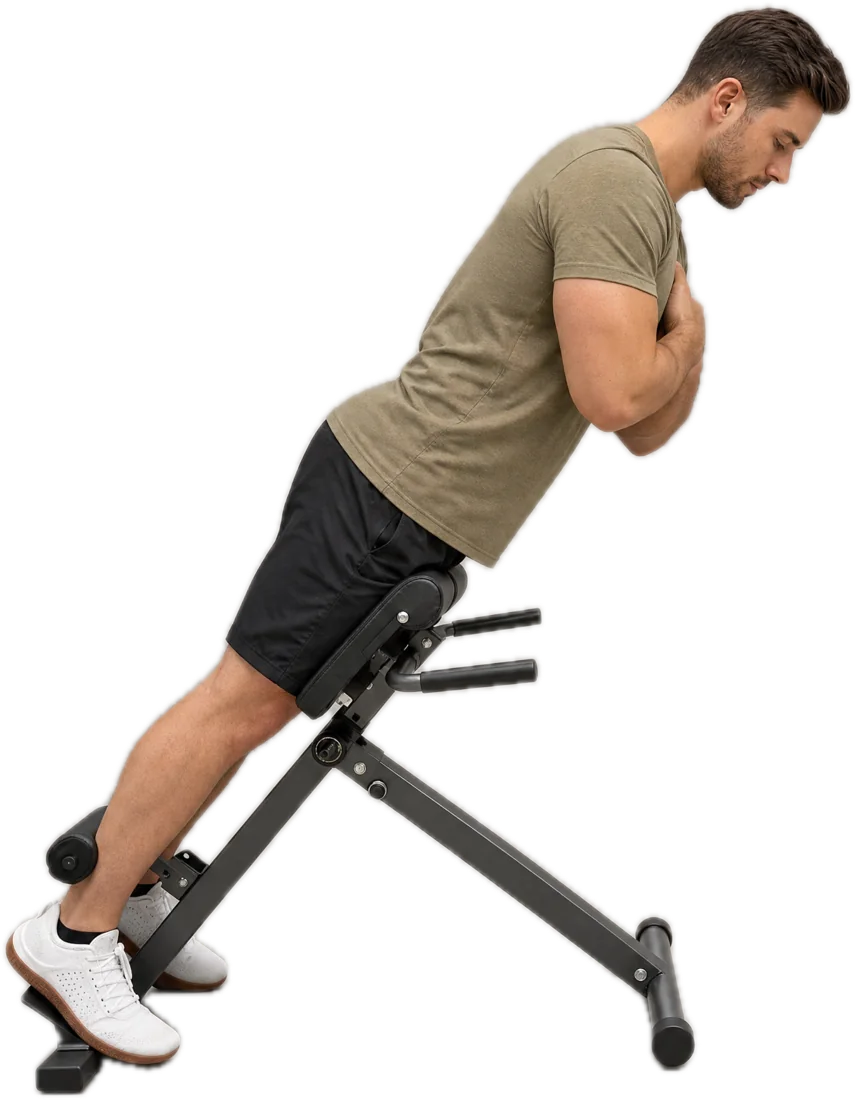
If you have suffered from chronic back pain for years, you have probably done the PT sheets and bought the lumbar pillow. I did. Pain was chronic and consistent. Some days were better than others.
Low Back Pain Coach is a four-stage back-extension program on a 45-degree bench. How your back feels the morning after each session sets the next one. No bench yet? The app starts you on floor work until you have one.
New to the bench? Week one on a 45-degree bench covers where the pad goes, where to stop, and what to write down tomorrow, with a free printable card.
What the guidelines say
Three clinical guidelines put exercise among the recommended treatments for persistent low back pain.
- World Health Organization, December 2023. For chronic primary low back pain in adults, it recommends education, exercise programs, some physical therapies such as spinal manipulative therapy and massage, psychological therapies and some medicines. It advises against routine use of lumbar braces, belts and supports.
- NICE guideline NG59 (England). For low back pain with or without sciatica, it advises considering a group exercise program, such as biomechanical, aerobic or mind-body exercise, for a flare-up or episode, and advises against belts and corsets.
- American College of Physicians, 2017. For chronic low back pain it recommends initially choosing non-drug treatment, with exercise among several options.
These guidelines back exercise in general. They did not test this app or this 45-degree bench progression. A 2021 Cochrane review of 249 trials found that exercise probably reduces pain more than no treatment, usual care or placebo. Compared with other conservative treatments the pain difference was small, and compared with manual therapy the review found no clear difference (Hayden and colleagues). No guideline promises a result for any one person.
Price comparison: what care and equipment cost
This is a price comparison, not a comparison of results. A clinician can examine you and check for a cause that needs different care, and an app cannot. Fees vary by city, and insurance copays depend on your plan and deductible. Each figure comes from the source linked beside it, as of the date shown. Retail prices change.
| What | Price | Source |
|---|---|---|
| Physical therapy session, cash | $118 MDsave national average, in a range of $42 to $179 | MDsave marketplace, 205 reviews from people who purchased, read October 4, 2026 |
| Specialist office-visit copay on employer plans | $45 average, for covered workers whose plan uses a copay for an in-network specialist physician visit. This is not a physical therapy figure. The American Physical Therapy Association says some physical therapy copays exceed $60. | KFF Employer Health Benefits Survey, October 2025, and APTA |
| How much physical therapy was used (a count, not a price) | 9.1 visits over about 8 weeks, among Medicare patients with newly diagnosed low back pain who had more than one visit. This does not say how many visits anyone needs. | Moran Company for APTQI, 2017, using 2014 claims |
| Chiropractic visit | $80 average fee, from $66 to $93 by region. This is the fee practices list, not what each patient pays. | Chiropractic Economics annual survey, 2024 |
| Massage, 60 minutes | $125 to $155 for a non-member at five Massage Envy locations. One chain, so not a market average. | Massage Envy location pages in Phoenix, St. Louis, El Paso, Minneapolis and San Francisco, read October 4, 2026 |
| A 45-degree back-extension bench, bought once | $295 to $365 across three retailers | ISF Fitness, Titan Fitness and Extreme Training Equipment, listed October 4, 2026 |
| Low Back Pain Coach | $59.99 a year or $9.99 a month, with a 7-day free trial for eligible new subscribers | App Store and Google Play |
For a wider view, US survey data for 2021 put out-of-pocket medical spending at about $1,902 a year for adults with chronic pain and $786 for adults without it (Guy and colleagues, Medical Care, 2025). The study used selected chronic noncancer pain diagnosis codes, not back pain alone, and the figures cover all of those adults' medical spending, not only spending on pain treatment. The bench is a separate cost, and the program needs one.
Why this app exists
The person who built Low Back Pain Coach had low back pain for about ten years, from his early twenties into his thirties.
He tried several treatments and exercise routines. A doctor prescribed anti-inflammatories. Chiropractors offered weekly adjustments. Physical therapy helped more than anything else, but it was expensive, and the exercises came on a printed sheet and never got harder. Dry needling, YouTube stretch routines and the McGill Big 3 didn’t change much for him. An MRI showed disc degeneration at two levels, which he later learned is common in people with no pain at all (what an MRI means).
What he did next was follow a slow back-extension progression on a 45° bench. He started with a few bodyweight reps. Over about eight months he worked up to loaded sets. He did a little, checked how his back felt the next day, and only then did a little more. His pain went down a lot.
He believes long-term back pain is partly physical and partly a spiral of avoidance: you protect your back because it hurts, it gets weaker from not being used, and the weakness and the worry keep the pain going. That is his explanation of his own back, not a research finding. He wanted a way to build strength slowly and check the next day, so he built an app he sells, Low Back Pain Coach, around that progression, with your daily pain log setting the next session.
Everyone's back is different, so results vary and aren't guaranteed. A Cochrane review of 249 trials found that exercise programs for chronic low back pain reduced pain on average compared with no treatment, usual care or placebo, by about 15 points on a 100-point scale at the first follow-up (closest to 3 months), and improved day-to-day function by a smaller amount. This exact progression has not been tested in a trial. The app is not medical treatment; talk to your doctor before starting a new exercise program, and stop and get help if you have any of the warning signs listed in the app.
You do two things at once
The physical part is a 45-degree back-extension progression: holds first, then partial reps, then full-range reps with your body weight, then a plate held at your chest. The app compares the morning after each session with your usual pain. A next-morning check-in below your usual steps the dose up when it is not higher than the pain you logged before that session. The same as usual repeats the session, unless the previous training day's next-morning check-in was also at or below your usual, and neither was higher than the pain you logged before that session. Higher cuts the next one back. A pain score cannot tell you what caused a change.
The other half, for me, was the fear that I would never get better. It was the first thought when I woke up and the last when I went to bed, along with the hopelessness that the pain would run the rest of my life. I did not drop the physical work. Keep the training.
Walking is part of the flare-up plan. The strength work is the loaded back extension. How it works, in full.
The four stages
Every stage starts easy. You move up when you meet the stage target on each of your last three training days (partial sessions do not count), you logged pain on at least 3 of the past 7 days with none above your usual level or in your legs, and your next-morning check-ins allow a step up.
Stage 1 · Holds
Hold still at the top. Starts at 3 holds of 15 seconds (the setup questions can set your very first session to 10, 13, 15, 18 or 20).
Moves on at a hold of about a minute, or about 3 minutes of holding across the session, with the conditions above.
Stage 2 · Partial reps
A short range below the top. Starts at 3 sets of 3 reps over half your range.
Moves on at a set of at least 5 reps at 80% of your range or more, repeated on each of the last three training days at this stage (partial sessions do not count), with the pain and check-in conditions above.
Stage 3 · Full reps
All the way down and back up. Starts at 3 sets of 5 with body weight.
Moves on at about 20 reps in a session, with the conditions above.
Stage 4 · Weighted
A plate at your chest. Starts at 3 sets of 8 with 10 lb.
Add 5 lb to every set and go back to 8 reps only after every set reaches 12 reps on each of the last two training days, both with a qualifying next-morning check-in.
No bench yet
This program requires a bench. If you do not have one yet, start on the floor today. A floor session is three rounds of a prone hold, 6 bird-dogs, and 8 glute bridges, about ten minutes in all. Stage 1 needs the bench. You can start it the day you have one: confirm it in the app and the next session is Stage 1, unless a flare or a leg-pain stop is on. If you already said in the setup questions that you have a bench and you are still on the floor, the app moves you on by itself when each of your last three floor training days includes a prone hold of at least 30 seconds (or 90 seconds of holding in total; partial sessions do not count), your pain is logged on at least 3 of the past 7 days with none above your usual level or in your legs, and your next-morning check-ins allow a step up. What to look for in a bench.
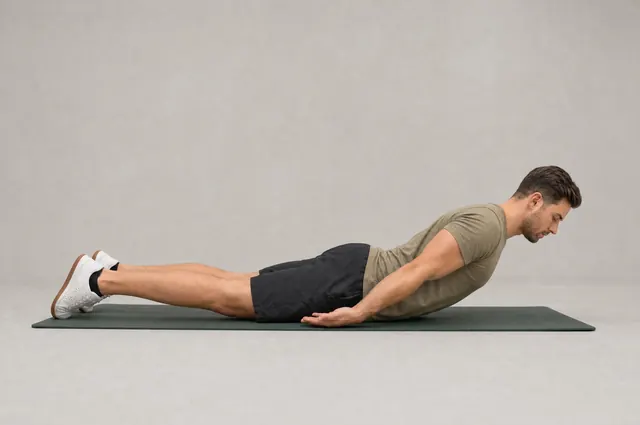
Prone hold. Lift the chest a few inches and hold. This is the number that grows.
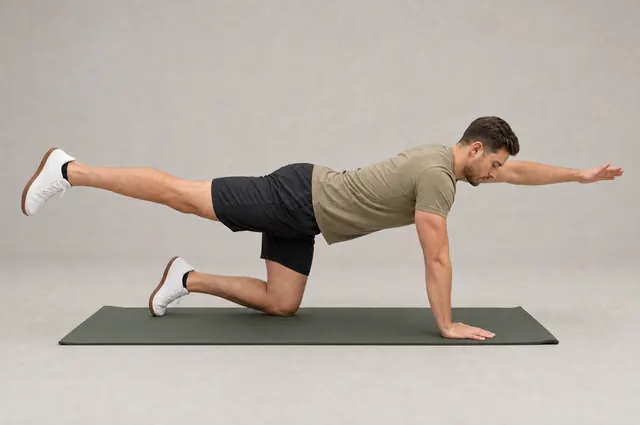
Bird-dog. Opposite arm and leg, 6 slow reps.
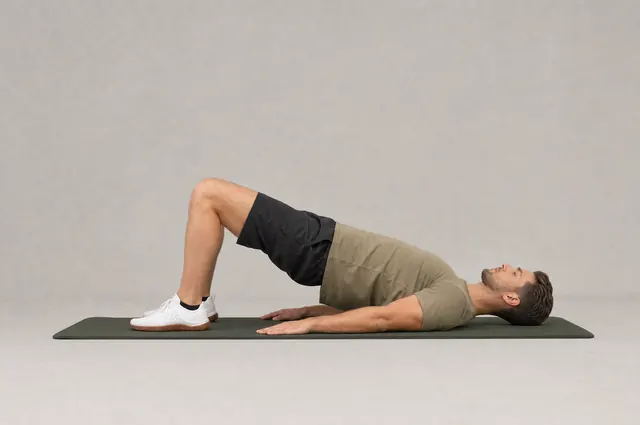
Glute bridge. Hips up until level, 8 reps.


How the next morning sets the next session
You start by telling the app your usual pain on an ordinary day, from 1 to 10. That is your baseline. The morning after a session you log how your back feels, and the app compares it with that baseline.
- Worse than usual: the next session is cut back. Holds and full reps drop about 30%, partial reps lose up to a rep and up to 10 percentage points of range (stopping at 2 reps and 40% range), and weighted sessions drop 5 lb while the plate is above 5 lb or lose up to 2 reps at 5 lb (stopping at 6). From Stage 2 on, a session already at the minimum steps back one stage. Stage 1 stays on the bench and eases to a minimum of 5-second holds.
- The same as usual: the app repeats the session, unless this next-morning check-in is at your baseline and the previous training day's was also at or below baseline, and neither was higher than the pain you logged before that session. Then it steps up.
- Better than usual: a small step up from that next-morning check-in alone, as long as it is no higher than the pain you logged before the session that day. That is 5 more seconds on the shortest hold (the first, if several match), one more rep on the set with the fewest, or, once every partial-rep set has at least 5 reps, 10 percentage points more range on every set. On Stage 4, one more rep on the lowest set until every set has reached 12 on each of the last two training days, both with a qualifying next-morning check-in, then 5 lb more on every set and back to 8.
- Pain in your legs: stop the extension work. The app shows no session while the newest log that records a location says legs. A legs log in the past seven days also blocks a dose or stage increase after a later reading is recorded in your lower back.
- A week or more off: the next session starts easier, whatever the logs say.
A rough week means a smaller dose. You do not throw out the program and start over. Flare-up mode pauses bench work while you walk and keep logging, then offers an eased first session after two days at or below your usual level (maintenance mode keeps its own dose). The flare-up plan.
Go to emergency care now if
- You have new numbness, tingling or a change in feeling around the groin, inner thighs, genitals or anus (the saddle area), or when you wipe.
- You have new trouble getting or keeping an erection, cannot orgasm, or feel a change during sex.
- You have new bladder or bowel changes: trouble starting or stopping pee, a weak stream, not feeling when you need to go, or leaking pee or poo.
- You have new pain, tingling, numbness or weakness in both legs.
- A leg or foot is getting weaker: you trip, or the foot slaps down.
- The back pain started after a recent serious accident, like a car crash or a bad fall.
Stop and see a clinician today if:
- You have other new weakness or numbness in one leg or foot.
- You have fever or chills along with the back pain.
- The pain is new after a recent smaller fall or knock.
- You have lost weight without trying, or you have a history of cancer.
- The pain is getting worse fast.
- The pain is constant at rest, worse at night, and does not change when you move.
Use urgent care if you cannot get an appointment today.
Pain in your legs during or after the exercise means stop the extension work and do not add load. If you had surgery or an injury in the past few months, do not start until a clinician has checked it and you have finished the recovery plan they set. More on each of these.
The app
I built Low Back Pain Coach to do the bookkeeping: it reads your logs, writes the next session, and a voice counts the holds, reps and rest so the phone can stay on the floor. It also keeps a pain graph against your baseline and makes a PDF of your history for a doctor or physical therapist. It works offline with no account. A notebook can run the same rules if you would rather keep the decisions on paper. Everything the app does, and what it costs.


Guides
Each guide lists its sources. Start with the progression or the next-morning rule.
Low back pain: what helps
- How to Fix Lower Back Pain? What the Research Says Helps
- Chronic Low Back Pain Exercises: What the Evidence Supports
- How Long Does Lower Back Pain Last, and How Long Does It Take to Get Better?
- How to Strengthen a Weak Lower Back (When It Already Hurts)
- Is It Safe to Exercise With a Bulging Disc or Disc Degeneration?
- Are Back Extensions Good for Lower Back Pain? What Research and a Slow Progression Show
- Stretching or Strengthening for Lower Back Pain? What the Trials Compare
- Lower Back Exercises to Avoid? What to Change Instead
- Physical Therapy Didn't Work for My Back: What to Try Next
- Lower Back Pain for Years: What the Guidelines Say to Try
- Is Walking Good for Lower Back Pain? What the Trials Found
- Should You Rest or Stay Active With Lower Back Pain?
- Do Core Exercises Help Lower Back Pain? What the Trials Found
- Does Bad Posture Cause Lower Back Pain? What the Research Shows
The program
- Back Extension Progression: From Holds to Weighted Reps
- Back Extensions Without a Bench: Floor Work Until You Get One
- Training With Lower Back Pain: The Next-Day Rule
- A Sample Month of Back Extension Training Logs
- Week One on a 45-Degree Back-Extension Bench: Pad, Stop Point, Tomorrow's Log
- The Numbers in the Back Extension Program, Explained
- Isometric Back Extension Hold: How to Do It on a 45-Degree Bench
- McGill Big 3 Alternatives: What to Try Next for Chronic Low Back Pain
- How Often to Do Back Extensions for Lower Back Strength
- How Long Does It Take to Strengthen Your Lower Back?
- Why does my lower back hurt on back extensions?
- Short Answers to Common Back Extension Questions
- Returning to Deadlifts and Squats After Low Back Pain
- What I've Changed About the Method
Safety and flare-ups
How long-running pain works
- Back Pain for Years: Why It Still Hurts
- Hurt vs. Harm: Does Back Pain Mean Damage?
- The Fear-Avoidance Cycle in Back Pain
- The Boom-and-Bust Cycle in Back Pain
- What Your Back MRI Report Means
- Back Pain After Physical Therapy Didn't Work: What to Check Next
- Chronic Back Pain Treatments: What the Trials Found
- How Poor Sleep and Back Pain Feed Each Other
- How Stress Can Make Back Pain Worse
- Lower Back Pain After Sitting or Driving
- Lower Back Pain After Standing or Walking All Day
The bench
- Is a Roman Chair Good for Lower Back Pain? Week One on a 45-Degree Bench
- 45-Degree vs 90-Degree Back-Extension Bench
- How to Buy a 45-Degree Back-Extension Bench
- What to Check on a Budget 45-Degree Back-Extension Bench
- Roman Chair Alternatives: Finding a 45-Degree Bench at the Gym
- Back Extension vs Superman for Lower Back Strength
- Back Extension vs Deadlift When Your Lower Back Is Sore
- Reverse Hyper vs Back Extension for a Sore Lower Back
- Sunny Health Roman Chair Setup for Back Extensions
- Marcy JD-3.1 Setup and the 45-Degree Bench This Program Uses
- Titan Fitness Roman Chair and Back Extension Bench Setup
- Budget Roman Chair Setup for CAP and VEVOR Style Benches
Choosing an app
More guides
- Do I Need an MRI for Lower Back Pain? What Guidelines Say
- Does a Back Brace Help Lower Back Pain?
- Heat or Ice for Lower Back Pain? What the Evidence Says
- Lifting Technique and Low Back Pain Research
- Is Pilates Good for Lower Back Pain? What the Trials Found
- Is Yoga Good for Lower Back Pain? Cochrane and Guidelines
- What Causes Lower Back Pain? What the Research Says
- What is sciatica? Reviews and the NICE guideline
- You Just Bought a Back-Extension Bench: What to Do First
The program on one page
The printable program card has the four stages, the next-morning rule, and the stop signs on one sheet.
If you want an email when the program or the app changes, leave your address. A few emails a year at most, and a reply to any of them takes you off the list.